
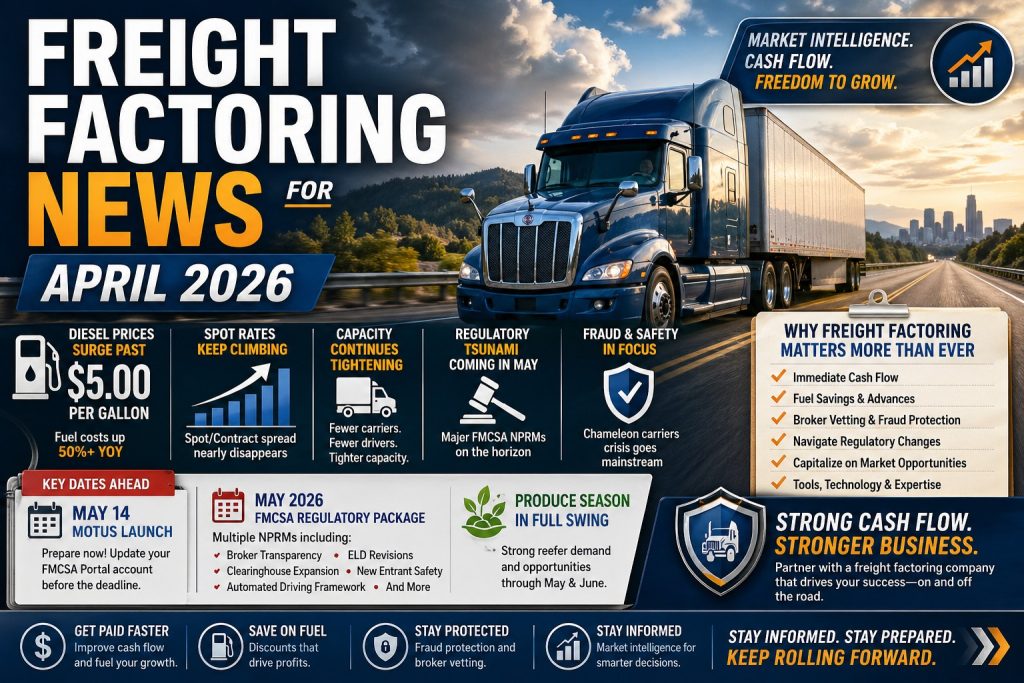
As we move deeper into spring 2026, the freight factoring industry is experiencing dramatic shifts driven by skyrocketing diesel prices, accelerating spot rates, and major regulatory developments on the immediate horizon. For truckers and small fleet operators, the past month has brought both significant opportunities and new challenges. Whether you’re an owner-operator or manage a small trucking company, understanding what happened in March and April, plus what’s coming in May and June, will help you make smarter decisions about your cash flow and business operations.
Diesel Prices Surge Past $5 Per Gallon
The biggest story of April 2026 is the dramatic surge in diesel prices. The national average for on-highway diesel hit $5.07 per gallon in early April—up a staggering $1.52 from a year ago and representing more than a 50% year-over-year increase. Some markets are seeing prices as high as $5.37 per gallon.
This surge stems directly from the ongoing conflict in Iran and the continued closure of the Strait of Hormuz, which has disrupted approximately 20% of global oil flows. While crude oil prices pulled back sharply from their war-driven highs by mid-April, diesel markets have been much slower to respond. The gap between crude oil futures and diesel prices at the pump matters tremendously for trucking operations.
For freight factoring customers, this diesel spike creates both a challenge and an opportunity. The challenge is obvious: fuel is still your largest single operating expense at roughly $0.48 per mile, and with diesel up 50% year-over-year, that’s crushing margins. The opportunity comes from factoring companies offering fuel card programs with per-gallon discounts and fuel advances. In an environment where diesel costs can swing wildly week-to-week, having access to discounted fuel and immediate cash to pay for it becomes invaluable.
Analysts expect diesel to stabilize between $4.50 and $5.00 per gallon through May and June, but uncertainty remains high. The geopolitical situation could change quickly in either direction. For carriers, budgeting conservatively and taking advantage of every fuel savings opportunity available through your factoring partner makes sense.
Spot Rates Continue Climbing Despite Fuel Costs
While fuel costs have surged, so have spot market rates—creating a race between revenue and expenses. Spot van rates hit approximately $2.58 per mile by early April, with some sources reporting rates up 18.6% week-over-week in mid-April for dry van. Reefer rates saw volatility, with strong performance out of South Texas and Florida as produce season ramped up.
The most significant development is that the spread between spot and contract rates has nearly disappeared. A year ago, contract rates ran about $0.41 per mile above spot rates. By March 2026, that gap had narrowed to just $0.11 per mile. This means the “safe” pricing shippers locked into contracts is now almost the same as what you’d pay on the open market.
For carriers, this creates leverage in contract renegotiations. Shippers who thought they secured good pricing months ago are now paying essentially market rates anyway. The current environment favors carriers with the financial flexibility to negotiate better terms, which is exactly what freight factoring provides.
However, it’s important to understand the math. While rates are rising, fuel costs are eating a significant chunk of those gains. With diesel adding roughly $0.36 per mile in additional costs compared to last year, carriers who improved rates by $0.50 per mile are only netting about $0.14 per mile in real improvement. The carriers winning right now aren’t just those getting higher rates—they’re the ones aggressively managing fuel costs through discount programs and maintaining strong cash flow.
C.H. Robinson Raises 2026 Forecast Dramatically
One of the most significant developments in April was C.H. Robinson’s announcement that truckload markets are tightening faster than expected, with 2026 costs now projected up 16-17% year-over-year. This is a substantial upward revision from earlier forecasts and reflects the reality that capacity constraints, carrier attrition, and rising operating costs are sustaining rate pressure even during typically softer seasonal periods.
This forecast revision is particularly noteworthy because it’s not driven by demand surging—freight volumes remain modestly higher year-over-year but not signaling a strong market breakout. Instead, the rate improvement is entirely supply-side driven. Carriers continue exiting the market, driver availability is tightening, and regulatory changes are removing additional capacity.
For freight factoring customers, this forecast suggests the rate environment should remain relatively strong through mid-year and potentially beyond. However, it also underscores the importance of maintaining operational efficiency and strong cash flow management, as the gains from higher rates could be offset by continued cost pressures from fuel, insurance, maintenance, and regulatory compliance.
The Chameleon Carrier Crisis Goes Mainstream
On April 12, 2026, CBS News’ “60 Minutes” broadcast a major investigation into chameleon carriers—trucking companies that illegally reopen under new names and DOT numbers after being shut down by the FMCSA for safety violations. The investigation focused on Super Ego Holding, a network of commercial trucking and leasing companies based in Serbia and the U.S.
This mainstream media coverage brought national attention to a problem the trucking industry has been struggling with for years. Chameleon carriers evade federal safety enforcement, create unfair competition for legitimate carriers, and put everyone on the road at risk. The investigation revealed that many of these operations are foreign-owned and operated, making enforcement difficult.
For legitimate carriers using freight factoring services, this crisis actually reinforces the value of your factoring company’s broker qualification and vetting processes. Good factoring companies check not just whether brokers pay, but whether the entire transaction appears legitimate. They can spot red flags that might indicate fraudulent carriers or sketchy operations. In an environment where chameleon carriers proliferate, having a factoring partner that adds this layer of scrutiny becomes a competitive advantage.
The “60 Minutes” exposure is likely to trigger increased FMCSA enforcement and potentially new regulations targeting carrier identity fraud. This could create short-term disruption but should ultimately benefit legitimate carriers.
Capacity Continues Tightening Across Multiple Factors
April 2026 saw capacity tightening accelerate across several simultaneous factors, creating what industry analysts are calling a “structural capacity squeeze.” Here’s what’s driving it:
Continued Carrier Exits: Market exits for trucking businesses slowed to the lowest level in years, but thousands of carriers are still shutting down. The carriers that survived the brutal 2023-2025 downturn are leaner and more disciplined, but the overall carrier population remains below historical norms.
Non-Domiciled CDL Enforcement: The March 16, 2026 effective date for tightened non-domiciled CDL requirements is now removing drivers from the market. With an estimated 200,000 holders of non-domiciled commercial driver’s licenses potentially affected, this represents significant capacity reduction playing out through April and May.
ELD Compliance Crackdowns: Fourteen ELDs were removed from the FMCSA-approved list in Q1 2026, bringing the total to more than 60 revoked since 2019. Carriers using decertified devices risk immediate out-of-service orders, and this is actively removing trucks from the road.
Driver Supply Constraints: Driver availability remains tight, and the non-domiciled CDL changes are making this worse. Fleets report difficulty finding qualified drivers even as they have freight available.
Seasonal Demand Increasing: April marks the beginning of produce season, with reefer demand rising sharply. Construction activity is picking up with warmer weather, supporting flatbed demand. These seasonal factors are overlaying an already-tight market.
The combination of these factors creates opportunities for well-capitalized carriers with good equipment and qualified drivers. However, it also means competition for loads remains fierce, and maintaining the financial flexibility to be selective about freight becomes critical. Freight factoring provides exactly that flexibility—letting you pass on marginal loads and wait for better opportunities without worrying about immediate cash needs.
Invoice Factoring Recognized as Market Stabilizer
An important development in April was growing industry recognition of freight factoring’s role in market stability. An article in SupplyChainBrain on April 10 highlighted how “invoice factoring is strengthening the freight market” by providing essential functions that brokers can’t replicate at scale.
The article noted that factoring companies are standardizing invoices across tens of thousands of carriers, quality-checking paperwork before it hits brokers’ desks, vetting carriers and loads daily, and absorbing the billing and collections burden that brokers never truly wanted. This recognition represents a shift from viewing factoring as a “necessary evil” to understanding it as essential market infrastructure.
For carriers, this growing recognition matters because it means factoring companies are likely to receive more support and integration from brokers and technology platforms. It also suggests factoring will continue evolving to provide more value-added services beyond just quick payment.
Recent industry data shows factoring volumes signaling market recovery, with more carriers factoring more invoices as freight activity increases. This is a positive indicator for the overall market and suggests the recovery is broadening beyond just spot rate increases.
What’s Coming: The May Regulatory Tsunami
The most important event on the immediate horizon is the massive slate of regulatory proposals scheduled for May 2026. After delaying numerous rulemakings throughout 2025, the FMCSA plans to release multiple Notices of Proposed Rulemaking (NPRMs) all at once in May. These include:
Broker Transparency Rule (Second NPRM): FMCSA is scheduled to release a second proposed rule on broker transparency in May 2026, following the first NPRM in November 2024 that generated over 7,000 comments. This could require brokers to provide detailed transaction information to carriers, improving payment clarity and reducing disputes. For factoring customers, this could mean better documentation and fewer payment delays.
Electronic Logging Device Revisions: An NPRM for ELD rule revisions is targeted for May 2026. Expect clarifications to technical specifications, certification requirements, and compliance expectations. This could affect which ELDs remain compliant and create a scramble for carriers using devices that don’t meet new standards.
Drug and Alcohol Clearinghouse Expansion: FMCSA plans to propose changes expanding the availability of driver violation information in the Clearinghouse. This likely means faster reporting requirements (potentially 24-hour windows) and more extensive data sharing. Carriers will need to stay on top of Clearinghouse queries and ensure compliance.
Automated Driving Systems Framework: By May 2026, FMCSA expects to propose rules addressing inspection, repair, and maintenance standards for autonomous trucks. While fully self-driving trucks are years away, this framework sets the groundwork for how they’ll coexist with traditional fleets.
New Entrant Safety Assurance: This could require new motor carriers to pass a written proficiency exam before receiving operating authority, demonstrating knowledge of federal safety requirements. If implemented, this raises the bar for new carrier entry.
Hours of Service Agriculture Clarifications: FMCSA plans to issue a final rule clarifying definitions for agricultural commodities, livestock, and non-processed foods for HOS purposes. This should finally provide clear guidance for ag haulers.
Safety Fitness Procedures: Updates to the process for revoking permits and removing unsafe carriers from the roadways. This could streamline the process for shutting down truly dangerous operators.
For carriers, May 2026 will require close attention to FMCSA announcements. Each of these proposed rules will have comment periods, but understanding what’s being proposed and how it might affect your operations is critical for planning.
The MOTUS Registration System Launches May 14
Another critical May deadline is the FMCSA’s launch of the new MOTUS registration system on May 14, 2026. This represents a complete overhaul of how carriers register and maintain their USDOT information.
Before May 14, all carriers must log into their FMCSA Portal and:
- Confirm their FMCSA Portal account is active
- Update contact information to ensure accuracy
- Verify all company details are current
Carriers who haven’t logged into their FMCSA Portal recently need to do this immediately. After MOTUS launches, you’ll need an active portal account to claim your USDOT number in the new system. Failure to complete these steps could delay your ability to register or update your information, which could impact your authority to operate.
This transition is part of FMCSA’s broader move toward the Unified Registration System (URS), which aims to improve registration processes, tighten controls against fraud, and change procedures for granting, suspending, and revoking registration. While the goal is to make things more efficient long-term, any major system transition creates short-term challenges and potential disruptions.
Produce Season Creates Reefer Opportunities
April and May represent prime produce season across southern states and both coasts, creating significant opportunities for carriers with refrigerated trailers. Reefer rates out of South Texas and Florida showed particularly strong performance in early April, with routes like McAllen linehaul running 26% above last year, Nogales to Boston clearing $10,000 to $10,600 per load, and Nogales to Chicago hitting $5,900 to $6,200.
The interesting dynamic is that many dry van drivers are pivoting to reefers to capitalize on this activity, which is tightening dry van capacity in some regions. This creates opportunities across equipment types—either running reefer freight directly or taking advantage of improved dry van rates in markets where capacity has tightened.
For carriers with factoring relationships, produce season is particularly well-suited to factoring because payment terms in produce can be even longer than general freight, sometimes extending to 45-60 days. Getting paid immediately on produce loads rather than waiting through the entire growing and selling season improves cash flow dramatically.
The produce season is expected to remain strong through May and into June, providing consistent freight opportunities for carriers positioned to take advantage of it.
Why Freight Factoring Is More Critical Than Ever
Given everything happening in April 2026 and what’s coming in May and June, freight factoring has become an essential tool rather than a nice-to-have option. Here’s why:
Manage Fuel Volatility: With diesel at $5+ per gallon and subject to geopolitical swings, fuel card programs offering per-gallon discounts can save thousands per month. Many factoring companies now offer fuel advances, letting you fill up immediately after delivery rather than waiting weeks for payment.
Capitalize on Rate Improvements: Spot rates are improving, but only if you can afford to run the loads. Factoring ensures you have working capital to take advantage of better-paying freight without worrying about when brokers will actually pay.
Navigate Regulatory Changes: The May regulatory package could create unexpected compliance costs or operational changes. Having reliable cash flow through factoring gives you financial flexibility to adapt quickly without depleting reserves.
Protect Against Market Volatility: With produce season, capacity tightening, and economic uncertainty all creating volatility, predictable cash flow becomes more valuable. Factoring provides that predictability regardless of market conditions.
Leverage Broker Vetting: With chameleon carriers and fraud at high levels, factoring companies’ broker qualification services provide valuable protection. They check whether brokers are financially solid before you haul the load, not after.
Access Value-Added Services: Modern factoring companies provide fuel cards, load boards, credit monitoring, fraud detection, and market intelligence. These services help you run more efficiently and make better business decisions.
Compete Effectively: Well-capitalized carriers with strong cash flow can be selective about freight, negotiate better rates, and maintain quality equipment. Factoring levels the playing field for small carriers competing against larger fleets.
Choosing Your Factoring Partner in This Environment
With market conditions shifting rapidly and major regulatory changes coming, choosing the right freight factoring company requires careful consideration:
Fuel Programs Are Essential: In a $5+ diesel environment, strong fuel card programs with meaningful per-gallon discounts aren’t optional—they’re required for profitability. Compare the actual discount per gallon and the network coverage.
Technology Matters More: With rates and costs changing weekly, you need real-time visibility into your cash position. Mobile apps, instant document upload, same-day funding, and integration with load boards and accounting software are table stakes.
Fraud Protection: Ask specifically about broker qualification processes, credit checking, fraud detection, and whether they offer non-recourse protection. With chameleon carriers and sophisticated fraud schemes proliferating, this protection is worth paying for.
Regulatory Expertise: The best factoring companies are tracking the May regulatory changes and preparing to help their customers navigate them. Ask what they know about MOTUS, the May NPRM package, and upcoming ELD changes.
Rate Transparency: In 2026, most freight factoring rates fall between 1.5% and 4% per invoice, with the exact rate depending on monthly volume, broker credit quality, and recourse type. Make sure you understand the total cost including any fees for wire transfers, same-day funding, or fuel advances.
Contract Flexibility: With so much uncertainty ahead, avoid long-term contracts with high monthly minimums. Look for month-to-month arrangements that let you scale usage based on your needs.
Customer Service Quality: When regulations change or market conditions shift, having a dedicated account manager who knows your business and can solve problems quickly becomes invaluable.
Looking Ahead: May and June 2026
The next two months will be pivotal for the trucking industry:
May 14: MOTUS Launch: All carriers must be prepared for the new registration system. Complete your FMCSA Portal updates before this date.
May 2026: Regulatory Package: Multiple FMCSA NPRMs dropping simultaneously will require careful review and potentially public comments. Each one could affect operations, costs, or compliance requirements.
Ongoing Capacity Tightening: Non-domiciled CDL enforcement, carrier exits, ELD compliance issues, and seasonal demand will continue tightening capacity through spring.
Diesel Price Watch: Monitor the geopolitical situation and fuel markets closely. Any resolution to the Iran conflict could bring diesel prices down quickly, or escalation could push them even higher.
Contract Renegotiations: With spot and contract rates nearly converged, expect aggressive renegotiations on both sides. Carriers have more leverage than they’ve had in three years.
Produce Season Peak: May and June represent peak produce movement, creating consistent freight opportunities especially for reefer operators.
Taking Action Now
Given the compressed timeline and multiple changes coming simultaneously, now is the time to ensure your freight factoring and financial systems are optimized:
Before May 14: Log into your FMCSA Portal, verify all information is current, and ensure you’re ready for the MOTUS transition.
Review Your Factoring Agreement: Are you getting the best rates available given current market conditions? Do you have access to fuel programs that could save significant money at $5+ diesel? Is your provider prepared for the May regulatory changes?
Evaluate Fuel Programs: With diesel at $5+ per gallon, every cent per gallon matters. Calculate potential savings from switching to a factoring company with better fuel card programs.
Prepare for Regulatory Changes: Set aside time in May to review the NPRM package when it’s released. Understanding proposed changes early gives you time to prepare and potentially comment.
Optimize Load Selection: In a tight market with improving rates, you can afford to be selective. Use your factoring company’s broker credit checks to avoid risky loads and focus on better-paying, reliable customers.
Plan Equipment Needs: If you need new equipment, consider acting before 2027 model year trucks arrive with mandatory AEB systems and higher prices. Strong cash flow through factoring can help finance purchases.
The Bottom Line
April 2026 has demonstrated that the freight market is genuinely recovering, but success requires more than just waiting for rates to improve. With diesel at $5+ per gallon, major regulatory changes coming in May, capacity continuing to tighten, and market volatility remaining high, carriers need every advantage they can get.
Freight factoring isn’t just about getting paid faster—it’s about having the financial flexibility to navigate volatility, the fuel savings to remain profitable at high diesel prices, the fraud protection to avoid bad brokers, and the technology platform to operate efficiently. The carriers thriving in April 2026 are those with strong cash flow management, disciplined operations, and smart financial partnerships.
Whether you run one truck or a small fleet, the next two months will bring significant changes that will affect your operations for years to come. Having the right freight factoring partner—one that provides immediate funding, fuel savings, fraud protection, regulatory expertise, and true partnership—makes the difference between struggling through the transition and emerging stronger on the other side.
The market is improving, but it’s far from easy. Rates are rising, but so are costs. Opportunities exist, but so do risks. The carriers who make it through 2026 and position themselves for real success in 2027 will be those who maintained discipline, protected their cash flow, and made smart decisions about financial partners when it mattered most.